Monday, September 26, 2005

Don't Believe the Skype?

In response to my fit of techno-evangelism about Skype, two people who, unlike me, sound like they actually know about computers write in with fairly convincing arguments against it.

From Galley Reader P.G.:
. . . don’t use Skype yet. It’s a security problem waiting to happen. We’ve banned it here at [redacted] because it opens various network vulnerabilities (Unicode bufferoverflow, DoS attacks) that while not as serious as any of the IE vulnerabilities, are still dangerous. If you want to stick it to Verizon (the DEVIL!!!!!!!), go out and get Vonage or some other established VoIP connection. Before you do so, make sure you’ve a battery backup in your home and a cell phone provider that you can get a signal from inside your house. The battery backup gives you internet connectivity when the power goes out for a few hours, and the cell phone so you can set your VoIP to forward to the cell phone when the ISP connection is down.

Some of the technical nitty-gritty is available here.

Yikes. Then there's this comment from The Smoking Room's Greg:
Since you've been getting flak from readers who don't like your Old Media defenses, let me express my surprise that you're such a huge fan of Skype. "Going to destroy the already-maimed traditional telecom companies"? I'm no defender of the legacy telcos, but this is beyond the blog boosterism of Jarvis and Reynolds. VoIM (voice over instant messenger) is indeed a cool technology and kudos to Skype for extending it past the IP network to traditional and mobile phones. Maybe Skype would have been a good purchase for Verizon, but its asking price was pretty far beyond what it had proved. It has tens of millions of downloads but no one's sure how many people are actually using it. As we've seen with Google Talk, which was preceded by PC-to-PC offerings from Yahoo and MSN, this is a field that's going to get crowded and Skype may not have the best long-term plans for monetizing it. And as we're seeing with the FCC kerfuffle, VoIP carries with it a host of complicated and expensive regulatory issues associated with the social obligations of the telcos. Verizon, News Corp. and other likely buyers might have been worried the added regulation would have outweighed their ability to profit from it. As a complementary voice service - not intended to replace an existing service - eBay might be able to actually increase its volume of business with little additional outlay. It's likely the telcos will move to an all IP backbone, as BT is doing now, but acquiring the standalone IP telephony providers may not be their cheapest route.

I'm reasonably convinced, unless others want to chime in. . .

Friday, September 23, 2005

Spoiler Alert

This AICN review of History of Violence is the best piece I've seen on the Cronenberg film yet. And he brings the funny:
Also it's apparently based on a comic book, so you guys are gonna like it. It is alot like Batman, Snoopy, etc. The one and only problem I had was in the very end (spoiler) when a Top Gun type jet made out of human skin flew down and vomited a bunch of phallises onto Viggo and he moaned in erotic pleasure as some creepy she-males gave him gratuitous reconstructive surgery. But I mean you know how Cronenberg is. He loves that kind of shit.

Layers and layers of funny.

The Real Jedi Library

Pardon my huttese, but Holy shit.

Memories of a South Jersey Childhood

No, I'm not going to foist any of my memories on you. But the Wershovenist Pig shares some of his in the course of his long exegesis on the Sears/K-Mart merger. This isn't indulgence on the part of the Pig, however, it's anecdotal evidence. If you've been listening to Jim Cramer pumping this deal, the Pig's careful analysis is a tonic--and might save you a few ducats:

Cramer doesn't talk up SHLD because it's a wonderful synergy of two dying retailers, K-Mart and Sears. He loves Sears because he want to make sweet sloppy love to Eddie Lampert. Cramer's hoping he's found the next Berkshire Hathaway. He's been trying to convince Mad Money viewers to buy this story, even to go so far as to convince those low on funds to buy a single share of SHLD.

That's a bit rich to me.

Read the rest and I suspect you'll be convinced, too.

(I'll note, for the purposes of disclosure, that many of my childhood memories from SJ track closely with those of the Pig since, basically, we were always hanging out at those malls together.)

In Defense of the Buggy Whip

In recent comments (here and here) two readers have taken issue with my continuing defense of the Old Media in general and the New Yorker in particular. John Veccione writes:
Your constant plumping for the old media reminds me of those guys who said "with the high quality of today's buggy whips, the noisy combustion engine will never rise to the use and majesty of old dobbin. In fact, the Old Media may roar around Pangeria making quite a show but there's a chill in the air and something small, furry and scurrying is eating its eggs!

And then anonymous writes:
What are YOUR fucking suggestions on how to deal with this problem? You sit around and throw shit at the President on issue after issue without ONCE giving a constructive thought or suggestion as to how such a smart guy like you would handle these problems.
I guess when one of your favorite magazines is The New Yorker, your concept of serious critical thinking is fucked.

My first reaction, of course, is that I don't know what conservatism means, if it isn't a serious defense of buggy whips.

But kidding aside, I'm quite open to the possibility that Veccione is right and that the New Media will destroy and supplant the Old Media. I'm not convinced that this is going to happen, but it certainly isn't out of the realm of the possible. My concern has always been, should the New Media supplant the Old Media, would that be good for us? I don't think so.

Which brings us to Anonymous, who--I hope she doesn't mind the paraphrasing here--believes that the New Yorker is not a serious home for writing and ideas.

To address both these comments I'd urge readers to dig out a copy of the September 19, 2005 issue and read David Grann's "The Lost City of Z." (For reasons that probably have to do with writers' guild lawsuits, Grann's pieces aren't on Nexis or the web.) My words cannot convey what a feat of reporting and writing this piece is.

It is conceivable that the blogosphere will someday produce something approaching the greatness of this Grann story. But I doubt it.

If the Old Media really is going the way of the buggy whip, if "The Lost City of Z" really is going to be replaced by "Heh. Indeed.", then I think we will all be incomparably poorer for it. Even serious people like Ms. Anonymous.

Believe the Skype

Now that Patrick Belton has come out of the Skype closet it's safe for me to do a bit of techno-evangelism. Get Skype. It's a cross between instant messenger and a telephone intercom and it's going to destroy the already-maimed traditional telecom companies.

Why Verizon allowed eBay to buy Skype instead of snatching it up for themselves is beyond me.

Thursday, September 22, 2005

Freudian Slip?

The New York Times reports that Sen. Biden was torn over his "no" vote on Roberts:
Mr. Biden said he had agonized over his decision, which he called "a very close call, a very close call." The senator said he had not been persuaded that Judge Roberts was sufficiently committed to rights of privacy, particularly on "right to die" issues.

But I thought the left was worried about abortion? Oh, wait . . .

Galley Friend J.E. notes, "Did I miss something? Has 'right to die' replaced 'reproduction rights' in the left's lexicon?"

A Blogger Who Gets It

Eric at Classical Values looks at the recent big-paper layoffs and understands why the old media is good and blog triumphalism is wrong-headed.

Very good stuff; must reading.

Mounds of Talent

In the current issue of Parade, James Brady goes "In Step With" actress/singer/hottie Jennifer Love Hewitt. Some highlights:

Asked to describe her new CBS drama, Ghost Whisperer, Love assures us "It's touching and effective."

Brady mentions her movie flop, The Truth About Love, as having done "very well internationally."

Love, on her shingle, LoveSpell Entertainment: "I like the business side. Now, when I read scripts, it's really fun, and I pay more attention. It gave me a newfound respect for the writers." Does this mean she now respects the writers of I Still Know What You Did Last Summer?

Writes Brady: "Jennifer credits CBS topper Les Moonves for getting her involved with Ghost Whisperer. 'I was at home in jeans with no makeup,' she said, 'and his office called. I've never been treated with such kindness--like an oldtime movie actress, like royalty.'"

Or like an incredibly hot 26-year-old actress wearing "jeans with no makeup." (No mention of a shirt, so let's just assume...)

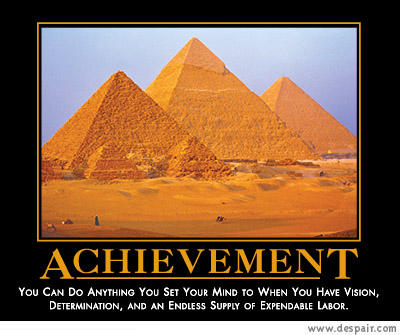
The Dilbert Life

Galley Friend A.L. sends this link to the Demotivators Collection. Very, very funny. Some examples:

Wednesday, September 21, 2005

Some Dare Call 9/21 the Feast of St. Matthew

Others know that it's much, much bigger than that:
Wiccans encircle an altar of fruit and bread as day turns to night in Central Park. The lush strains of a nearby performance of Puccini's "Turandot" blend with the prayers of an ancient Celtic harvest festival.

Wicca is a modern reconstruction of the pre-Christian nature-based religions of Europe.

"There is an exquisite, ecstatic sense of the sacred," said Phyllis Curott, lawyer, author and the priestess of the Temple of Ara.

"You literally feel your heart open. Being in the circle is like being in the womb of the great Goddess."

To get the full sense, you need to click through to the picture.

Esq., Priestess

The Shame of Darfur

First Things, one of my three favorite magazines on the planet, has a great issue this month, but the flagship piece is a long essay by Allen D. Hertzke on the tragedy in Darfur. It makes for difficult reading for anyone concerned with human suffering, but particularly for supporters of President Bush.

Print it out and sit down with it tonight.

Answer: No one knows!

Question: How many Frenchmen does it take to hold Paris?

Galley Friend B.W. sends this amazing link:

"Perhaps French Foreign Minister Philippe Douste-Blazy might want to visit Britain for next year's Holocaust Memorial Day, which is held on January 27. Yesterday's Ha'aretz reports that Douste-Blazy revealed a shocking lack of knowledge of the Holocaust and European history during a recent visit to Israel's Holocaust memorial site, Yad Vashem.

"The museum, which is an extraordinary achievement in public history, includes detailed maps showing the number of Jews killed in each nation occupied by the Nazis. Douste-Blazy asked why no British Jews were listed as murdered, prompting the museum curator to point out, 'But Monsieur le minister, England was never conquered by the Nazis during World War II.'

"The Foreign Minister's response: 'Yes, but were there no Jews who were deported from England?' Amazing."

Bubble Trouble

This isn't exactly not-safe-for-work, but it is disturbing.

The Next Chancellor

The latest rumors from the Fatherland have it that neither Angela Merkel nor Gerhard Schröder will be long-term chancellors in a Grand Coalition. Rather, both sides are said to be seeking out a compromise candidate. Here are a few politicians who have so far been mentioned:

1. Roland Koch. As the governor of Hesse, Koch has built himself a loyal and conservative following. There were rumblings during the CDU convention that he might make a play to win his party's nomination over Frau Merkel. But Koch is wisely biding his time. And once the dust settles, Germans may turn to him for answers, experience, and leadership.

2. Christian Wulff. Just like in America, there is nothing more interesting than a conservative (at least nominally) winning in a liberal state. Think Giuliani or Schwarzenegger or Bret Schundler--at least for a moment. Wulff governs Lower Saxony, a traditional SPD and blue-collar stronghold. CDU politikers want to know how he does it and can he do it for the nation. Others think of Wulff as a lightweight and still in need of experience. Ultimately he will be one to remember in the next ten years.

3. Peer Steinbrück. The former governor of North Rhine-Westphalia may be down but he's definitely not out. Still involved in SPD politics and a member of the Bundestag, Steinbrück is often mentioned by Social Democratic insiders as the future of a party that has lost its way. But as long as the CDU/CSU have more seats in parliament, Steinbrück is a long shot.

4. Palpatine. Hailing from the Bundesland of Naboo, Palpatine worked his way up through humble origins until reaching prominence in the Senate. He is known to preach peace but willing to take tough actions when necessary. Interested primarily in restoring order to the Republic, which currently has more than 11 percent unemployment, a Chancellor Palpatine may be just the antidote for Germany's woes.
Famous people can be nice! Who knew?

Tuesday, September 20, 2005

Only the Penitent Man Shall Pass

So you thought I would let this day go by without mentioning the Miracle at Dallas? As I earlier mentioned, I believe that God has a plan for the Redskins. But He also works in mysterious ways. So what can we divine from Mark Brunell's two touchdowns with less than four minutes left in regulation? Was it the Breath of God that launched that 70-yarder, landing it right in the hands of Santana Moss? Can there actually be life for a QB in his mid-30s? Perhaps Brunell has come to grips with his skills and shortcomings, prayed heavily for guidance and intercession and no interceptions. Like Doubting Thomas, I am still not convinced this man is the one. For think of all the false messiahs we have seen: Brad Johnson (more like a prophet). Jeff George. Tony Banks.

I know what the fans are saying. Ye of little faith. Or happy are those who believe but do not see. Sadly, I turned off my TV at the end of the third quarter, so I truly did not see, and thus, I can barely believe.

Now What?

For the last week I've been in Bonn and Berlin covering the recent German elections, which resulted in no clear winner. On the one hand the CDU/CSU now have more members than any single party in the Bundestag. On the other hand, because their number dropped from 38.5 percent of the electorate in 2002 to some 35 percent, they and their traditional partners, the Free Democrats, no longer have enough seats to form a government. At the same time, the SPD and the Greens also do not have enough seats to continue ruling. Besides the possibility of a Grand Coalition (CDU/CSU and SPD) and an alliance of leftists under Schröder, there is also talk of a possible Black (CDU/CSU's color), Yellow (FDP), Green coalition, also known as the Jamaica coalition. This is highly unlikely unless the Greens are willing to make major concessions as a junior partner. Right now, the odds are in favor of a Black-Red alliance. If so, there are rumors that the new foreign minister would be Otto Schily, the current minister of the interior. Current estimates as to how long it will take before Germans have a new government run from a few days to two weeks.

Terri Hatcher

Two words for Mr. Donnelly: Cool. Surface.

Monday, September 19, 2005

Left-Wing Bloggers: Take Note

This is how an effective, vibrant opposition should conduct itself.

It's funny, congenial, and not a single cuss word!

The Discount Shopping Thesis

The Wershovenist Pig has a Big-Think thesis for buying stocks:
Discounters and chain stores that offer more consumer value will do better in a tighter economy than mid-level and high-end stores, right?

You should chime in to encourage or dismantle this argument, as the Wershovenist Pig will soon have dollars riding on this sort of abstract thinking.

To this end, he now has an analysis of Wal-Mart vs. Target which you'll no doubt find edifying.

Minority Rule

John Hinderaker makes an excellent point about Democrats and Judge Roberts:
This whole Supreme Court nomination story has gotten a little weird, with everyone in suspense over whether the minority Democrats will approve Bush's nominees. Who cares? Since when does the Senate minority get to establish the critieria for Supreme Court nominations? When Clinton nominated Ruth Ginsburg in 1993, do you remember any discussion of what she would have to do to satisfy the Republicans? No, neither do I. (In the event, she did nothing, and they voted for her anyway.)

The Bull Moose has a similarly smart post:
Roberts is a conventional conservative not a right wing revolutionary jurist.

People for the American Way knows this. The American people know this. The Family Research Council knows this. Ted Kennedy knows this. Sam Brownback knows this. And they will all take their predictable side on the question of his confirmation.

John Roberts is not the Moose's cup of tea. He will undoubtedly be far too differential to corporate power. But, alas, his candidate for the Presidency lost. And one of the consequences of an election is that the winner chooses Supreme Court vacancies. The view from this bench is that the President gets the benefit of the doubt on nominations - elections have consequences. . . .

Probably, the majority of the Democratic Senators will oppose Roberts. That is tactically unfortunate because their opposition will have less resonance if the President truly nominates an extremist for the O'Connor vacancy - the donkey crying wolf syndrome. Is the Democratic Party merely the sum of its interest groups? It is not unlikely that a large number of Democrats prefer controversial issues such as gay marriage and the pledge of allegiance to be resolved in the legislative process rather than be circumvented by judicial fiat.

Sometimes, an opposition has to dare to say "yea".

As always, the Democratic party would do better if they listened to the Moose.

Bonus: Beldar notes the stunning difference between the NY Times and Washington Post editorials on Roberts. I think we can safely attribute the Post's huge advantage to Ben Wittes. Wittes is one of the finest legal affairs writers in America and while the Post benefits from having his pen for their editorials, I wish he was able to step out under his own byline more often--he deserves the spotlight.

If I was Gail Collins and I was faced with an op-ed vacancy from, say, Paul Krugman, Wittes would be a blockbuster hire.

Mission Impossible

This stuff is pure Ethan Hunt. And awesome:
Sounds from typing on computer keyboards are distinctive enough to be decoded, allowing security breaches caused by "acoustic snooping," University of California, Berkeley researchers said on Wednesday.

The researchers said they were able to feed sound recordings of typing on keyboards into a computer and use an algorithm to recover up to 96 percent of the keyboard characters entered by typists.

42-3

I didn't realize that the Eagles were playing the University of San Francisco.

Not that this game means anything. People frequently forget that in the NFL, the first six games of the season have little value so long as you don't got 1-5. The important thing is to make it to December without any major injuries. That's when the season really starts.

So since it's Monday night, let the trash talking between the Cowboys and Skins fans begin. But I'll ask the question on everyone's mind: Is Jenny going to wear her old Aikman jersey while she watches the game?

Friday, September 16, 2005

In Defense of a Friend

Andrew Sullivan takes a cheap shot at Hugh Hewitt today (even while agreeing with him), calling Hewitt "the Sid Blumenthal of the Bush administration."

Forget all of the many large ways in which this comparison is silly. There is one small, but very telling difference: Nearly everyone who knows Blumenthal--even his political allies--despises him. Nearly everyone who knows Hewitt--even his political adversaries--likes him.

If you're the type of person who thinks that character counts, then it's impossible not to number Hewitt as one of the good guys, regardless of his (or your) politics.

Update, Sat., 12:14 p.m.: Power Line has a list of reasons why the comparison of Hewitt to Blumenthal is ridiculous. A commenter here has something else to add:
If Hewitt is to Bush as Blumenthal was to Clinton, may I propose that Sully is to Bush as Bill Bennet was to Clinton?

That is to say, a humorless self-righteous prick who is quite certain he's never been wrong about anything. Ever.

Brian Williams Reports

You decide:
I am duty-bound to report the talk of the New Orleans warehouse district last night: there was rejoicing (well, there would have been without the curfew, but the few people I saw on the streets were excited) when the power came back on for blocks on end. Kevin Tibbles was positively jubilant on the live update edition of Nightly News that we fed to the West Coast. The mini-mart, long ago cleaned out by looters, was nonetheless bathed in light, including the empty, roped-off gas pumps. The motorcade route through the district was partially lit no more than 30 minutes before POTUS drove through. And yet last night, no more than an hour after the President departed, the lights went out. The entire area was plunged into total darkness again, to audible groans. It's enough to make some of the folks here who witnessed it... jump to certain conclusions.

New York Times Select

If David Brooks keeps writing columns like this one, eventually we'll all be forced to cough up our $50, even though we won't admit it to anyone else. Really, this is home-run stuff:
John Roberts Jr. Aw, shucks. This has been a humbling experience, Mr. Chairman. To think that a boy from an exclusive prep school and Harvard Law could grow up and be nominated for the Supreme Court - it shows how in America it's possible to rise from privilege to power! That's the hallmark of our great nation. . . .

Jeff Sessions This may be a good moment to remind my colleagues on the other side of the aisle that in this country unelected judges don't write the laws. We have unelected lobbyists to do that. Under our system, judges merely interpret the law and decide presidential elections. . . .

Edward Kennedy Starry De Cysis? Didn't she do a fan dance down at that old burlesque house in Providence?

LUGs Forever

Ross Douthat has a macro post on the CDC sexual behavior data, in which he notes as an aside that female bisexuality has become
a significant phenomenon nonetheless - and I'm willing to bet that if you broke it out by age and class, bisexuality would be even more common (and increasingly common) among upper-middle-class young people. If the experience of human history shows anything, it's that a large percentage of any given population will experiment with opportunistic homosexuality if the taboos against it are lifted - and at least in our country's more exclusive circles, the lesbian-experimentation taboo is dead . . .


So this long profile of Jen Sincero, seems to be hitting at the right time: Sincero is the author of The Straight Girl's Guide to Sleeping With Chicks--a book about being a heterosexual girl who likes to make it with other girls. As a publishing endeavor, this project has Can't Miss written all over it.

I don't have anything to add to serious discussions about human sexuality, although comments like this one make me wonder if the trend is liberation, or just another instance of women going out of their way to attract male attention by any means:
Ashley, 20, a student at Northern Arizona University, agrees. "It's become this totally hot thing," she says. "And the reason why is that it promises this sexual experimentation to guys. They think, 'She'll kiss another girl; she's gotta be pretty wild.'"

Ashley hasn't made out with that many girls: "I've only done it like a dozen times." It's been fun, she says, but mostly because of the titillation: "There's people watching it, and that makes me feel good. The first time I did it at a party, I thought, 'So this is what it takes to get the guys' attention.'"

You decide if this is benign or a case of women desperate for male affection. (You know you're old when you read Ashley's quote and instead of thinking, Hot!, you worry that she didn't have a capable, present father while she was growing up and hope that she'll spend some time working on her sense of self-confidence and self-worth.)

In any case, what interests me most is the proximate causes of what destroyed the "taboo" against LUGiness in the first place.

While the LUG phenomenon has been around for a long time, it used to be kept quiet. At some point it became a sign of rebellion and then it morphed into a hallmark of elite chicness. And then it spread into the mainstream of popular culture as just another thing that people do.

I would suggest that the LUG phenomenon was in its quiet phase all through the '40, '50s, and '60s and didn't become marker of youthful rebellion until the '70s (which, as David Frum reminds us, is when the '60s really happened).

Sometime during the '80s, LUGiness began to travel upwards through the social strata until it became the province of the very, very chic. By 1990, you had a daring, NC-17 art movie with Uma Thurman playing June Miller and Maria de Medeiros playing Anaïs Nin. But movies are lagging social indicators, so it's hard to figure out exactly when this shift came.

But I would argue that it's easy to pinpoint the death of the LUG taboo in mainstream popular culture: 1994, with the airing of Friends. Friends was one of the prime culture movers of the '90s. It sparked dozens of spin-offs, helped popularize the coffee-house culture that Starbucks was trying sell America, revitalized the formula sit-com--it even ushered in the age of the nipple erection on network TV. (I've always believed that this last bit is what helped popularize the show in the first place. Tune in to NBC on Thursday nights and see a really funny show about nothing followed by three hot chicks with their headlights on!)

One of the enduring sub-plots lurking beneath the show's patter was the undercurrent of Joey and Chandler wanting Monica and Rachel to hook up. This became a running joke as the show went on, culminating in an episode where the guys agree to give the girls back their apartment if they'll make out in front of them for five minutes.

Because of Friends, lots of other LUGiness made its way into the culture in the '90s, from popular movies such as Bound and Wild Things and Cruel Intentions to the girl-on-girl action in Ally McBeal, all of which was done on a totally commercial level--no NC-17 or obscure art-house stuff here.

If the taboo against casual female bisexuality is really dead, as Douthat suggests (and I think it is), I think we can credit (or blame) Friends for killing it.

Update, 2:38 p.m.: Kathy of Cake Eaters adds something very, very astute:
Jonathan ultimately places the blame on Friends with Monica and Rachel making out in front of Chandler and Joey to get their apartment back. I think Jonathan's partially correct: Friends showed two women making out. What he misses, however, is that these two female characters were making out not because they were hot for one another but because they were trying to get what they wanted (their apartment) from men. That's when the taboo died: when it became cool to use said bisexuality to lure men into handing over what women wanted. Female bisexuality became a tool to manipulate men. Everyone knows that hetero men adore it when women get busy with one another. There's nothing new in that bit of information. What is interesting in all of this, however, is the lengths women feel they need to go to to get what they want. If making out with a woman will get them something, well, they'll do that.
The Blog Crush has faltered with his ridiculous slag-off on Liv Tyler:
Liv Tyler is maybe the only "amazing Hollywood beauty" who, if she tried to kiss me, I would do that thing where I lean back a little and instead offer her a hearty handshake. And not just cause she got so heavy. Her features don't really come off as attractive in real life. And also cause she got so heavy. I don't want to call her fat, but if she and I ever work in an office that sends us on a retreat, and we're partnered up to do trust falls, she's going to have trust issues from now on.

I say, Hey, she-elf, keep the ears on.

Also, girl-Friday Jenny offers the following headline: " Chesney is too phoney, Hewitt is too clothed and Moss is too high." You know you spend too much time in the blogosphere when you read that and think, My God, what has Hugh done?

November 18

Mark it down. It's the opening of Goblet of Fire. The new trailer makes it look as though Newell may have gotten the best book in the series right.

Get Your Fresh CulturePulp!

Mike Russell goes to Oktoberfest, and learns the facts behind the traditions.

Bush in New Orleans

Tom Maguire's reaction strikes me as about right.

Update, 11:03 a.m.: Dean Barnett has another clear-eyed view of the president's speech, but first, here's a dash of the funny:
I don’t condemn the administration for taking a pass on the disaster pros. But if deposed FEMA honcho Mike Brown had any outsized talents, he has to date kept them carefully concealed. FEMA is not the place for cronyism; if it were, God never would have invented the Commerce Department.

Now onto the damning stuff:
President Bush last night gave what was perhaps the most disappointing speech of his political career. Last night’s effort made the 9/11 Awful Office address look downright Churchillian. He might as well have said, “Message – I care.”

And because he cares, he’s going to throw a lot of money at every conceivable problem caused and exacerbated by Hurricane Katrina. Scratch that – he’s going to allow our spendthrift congress to throw money at the putative problems which will no doubt be even worse. He practically declared a second “war on poverty.”

Don’t believe me? Then take this as a sign: Notorious race-relations and poverty pimp, the “Reverend” Jesse Jackson, actually scored a primetime gig on Fox last night. Jesse’s got a seat at the table again because Bush has brought this particular table out of the closet and set it. Bush’s speech has opened the door to rubbish like this, and closing it any time soon will be all but impossible.

What really bothered me about the speech is that it was a big and lasting response to a temporal political concern.

Thursday, September 15, 2005

Potent Potables

The Blog Crush's hired hand points out this site, which has a collection of all of the SNL "Celebrity Jeopardy" sketches. That should amuse you for the rest of the day.

Wednesday, September 14, 2005

Breaking Up the Band

It's a sad, sad day. Does this mean that the good times are gone forever?

(If you skip that second link, it's on your conscience. You're only missing the picture that defines a generation.)

Tuesday, September 13, 2005

What Makes Me Grouchy

Kids say the dumbest things. I have no idea what the editors at WashPo were thinking, but bext, they'll probably tell us that being a goody two shoes makes you a better student—a message already being sent out by quite a few pseudo-education-minded nonprofits.

No Quarter(back)

When I met Joe Gibbs and Mark Brunell some months ago, I instantly recognized the two had a sacred bond. Either in prayer or on the field, there was something about them and their dynamic--one being a Hall of Fame coach and the other recently rated one of the worst quarterbacks in the league. Thus it didn't come as a surprise to me that Brunell would inevitably become the Redskins' starter. And so it was by an act of God that Patrick Ramsey got himself injured last Sunday, opening the way for this divine intervention to take place. Monday Night Football, Washington at Dallas (Cowboys by 6 according to the latest spreads).

I remember listening to Coach Gibbs talk about the importance of faith and that God has a plan for everyone. And I believe he is right. God does have a plan. To destroy the Washington Redskins.

Monday, September 12, 2005

On Ferguson

Ross Douthat has a number of serious questions for John Hinderaker.

I'm Confused . . .

If he was doing a heck of a job, why is he being allowed to resign?

And why did he wait to resign until the Roberts confirmation had begun, instead of stepping down sooner, if it really was in the "best interest of the agency and best interest of the president"? Was it not in FEMA's best interest to resign sooner? Or was it not in the best interest of the president to resign sooner?
It is unfortunate that in the midst of such events as the recent hurricane and the beginning of the Roberts hearings, that certain other news items may be overshadowed. Months or years later you end up wondering What ever happened to...

One such case I had thought of recently was the birth of Susan Anne Catherine Torres, born premature to her mother, Susan, who had been brain dead but kept on life support long enough for a delivery. As Stephanie McCrummen reports for the Washington Post today, the five-week-old baby passed away on Sunday after complications in surgery.

"Down with America"

The Brussels Journal has a depressing post on the latest pop tune in Belgium, Raymond van het Groenewoud's "Weg met Amerika"--or, "Down with America." A selection of lyrics:
Hamburgers and coke, yes you already knew
But do you also know the cause of the general decay?
Short-sighted thinking, loud talking
Sticking to one-liners forever
Down with America! Down with the jerks from America
Down with America! [...]

Down with American colonialism
Down with that ugly, biting English
All the Anglo-Saxon pretence, arrogance
Yes, a hot pick up their ass
And that is that [...]

I am from the Belgian, the European panel
And I ask you: “Clear my channel! Clear my channel!”
Megalomaniac unicellular idiots
Kiss my ass, yes, kiss my balls

Luc Van Braekel has more.

Update, 12:02 p.m.: Galley Friend J.E. writes in:
The song would be funny, were it not so sadly ignorant of history. I suppose the songwriter, who decries "American colonialism," has never learned of Belgium's shameful colonialist past, resulting directly in the Rwanda slaughter, for it was the Belgians who created the artificial ethnic constructs of Tutsi v Hutu. Where, exactly, are the American colonies? Oh, and let's not forget the 18 days it took the Belgians to surrender to Hitler in 1940, nor their willingness to give up Jews, nor the liberation of Belgium by our guys, nor the loss of life at the Bulge.

Apparently, there is a large leftist moron factory somewhere in the world turning out idiots from every culture 24/7.

Name that Blogger

In The Weekly Standard's 10th anniversary symposium, smart people are asked, "On what issue or issues (if any!) have you changed your mind in the last 10 years- and why?"

Andrew Ferguson's answer is the best, naturally. But this passage sticks out in particular:
Under the circumstances, it's not much of a surprise that the threshold Buckley tried to maintain has collapsed. I suppose any philosophical tendency, as it acquires power and popularity, will simplify itself, define itself downward. That's democratic politics for you. But something more corrosive is also at work. Marshall McLuhan was righter than anyone ever would have guessed. The medium really is the message. Conservatism nowadays is increasingly a creature of its technology. It is shaped--if I were a Marxist I might even say determined--by cable television and talk radio, with their absurd promotion of caricature and conflict, and by blogs, where the content ranges from Jesuitical disputes among hollow-cheeked obsessives to feats of self-advertisement and professional narcissism (Everyone's been asking what I think about . . . You won't want to miss my appearance tonight on . . . Be sure to click here for my latest . . . ) that would have been unthinkable in polite company as recently as a decade ago.

Who on earth could he be talking about?

Three Cheers for CBS!

Yes, that CBS. The Tiffany Net News has launched Public Eye, and ombuds-type blog over at CBSnews.com (which is run by the exceptionally able and very smart Dick Meyer).

Normally, one might scoff at this sort of project as being so much window dressing, except that CBS has wisely put Vaughn Ververs in charge of the blog. Ververs is a long-time hero from The Hotline. Ververs is simply a stud journalist and a serious guy. CBS deserves all sorts of plaudits for this move.

Update, 3:30 p.m.: Yes it's "Vaughn," not "Vaugh."

Sunday, September 11, 2005

An Old Man's Luck

Andre Agassi doesn't have a chance to win against Roger Federer. More to the point, Agassi doesn't have a chance to even win a set against Federer. Federer is that good; Agassi is that old.

Yet here we are, Agassi up a break in the second, and playing like a champion. If he can get his first serve percentage back up, keep Federer away from the net, and keep pounding away on the kid's backhand . . .

To be honest, even if all of those things happen, it would be an enormous achievement for Agassi to simply get a set off of the number one player in the world. And you know what? That doesn't take anything away from what he's done ove the last two weeks. In fact, it only underscores Agassi's greatness.

Saturday, September 10, 2005

Agassi, Ginepri

Mary Carillo, John McEnroe, and Dick Enberg make up the best commentary trio in all of sports. Talking about Agassi's career today, Carillo remarked, "It's never too late to be what you might have been."

Good stuff.

Update: Galley Friend J.E. writes in:
The "never too late" quote you cite is from George Eliot, author of the scourge of every 10th grade English student, "Silas Marner." If only the book had been as good as the quote.

The real news here is that Mary Carillo is a former professional athlete who reads George Eliot!?! Who knew?

Friday, September 09, 2005

Notes from Under Water

Matt Labash has the best piece yet written on Katrina and New Orleans. Amazing stuff:
In the parking lot outside the hangar sits George Lainart, a police officer from Georgia, who has led a flotilla of nine airboats over land to try to pitch in with the rescue. But his crew has been on the bench for two days, waiting for FEMA to assign them a mission. After making serial inquiries, Lainart is climbing out of his skin, and I later find out that his team circumvented FEMA altogether, got down to New Orleans, and stayed busy for five days straight. Though he shredded his hull by running over asphalt, cars, fire hydrants, and other debris, his crew saved nearly 800 people.

"FEMA was holding up everything, they didn't have a clue," complains Lainart. "They were an absolute roadblock, nobody was getting anywhere with those idiots. Everybody just started doing their own missions." While opinions on the ground differ wildly as to who deserves the most generous serving of blame pie among George W. Bush, Louisiana's governor, and New Orleans' mayor, everyone I speak with agrees that FEMA officials should spend their afterlives in the hottest part of Hell without any water breaks.

There's more:
Gloria, a kindly British-accented volunteer and an LSU English professor, tries to comfort her, and to get some answers from somebody. But nobody has answers. "Now, now, your world's been turned upside down, hasn't it?" commiserates Gloria, who tries to calm Lurleen down. It's the only attempt at consolation that I personally witness from even a semi-official source in the four days I spend in Louisiana. I have to leave, so I slide Lurleen 20 bucks, throwing my arm around her to give her a squeeze. She grabs me back like I'm a life preserver, saying, "God bless you" over and over again, hungry for the most meager kindness.

I walked the avenues of lower Manhattan in the days after the World Trade Center went down, and the camaraderie of people coming together was palpable. But Louisiana after the flood is different and darker. Perhaps it's the scope of the catastrophe, perhaps the undercurrent of violence, but even many of the aid workers seem to have turned to stone.

And more:
As I walk across the field toward the highway, I'm accosted by grasping humanity. Half of them want to know if I'm an aid worker, the other half want me to "call their people," which I try, but there's no cell service in New Orleans. Two thirtysomething black gents, who introduce themselves as Gregory and Richard, want me to see the squalor of their encampment, which could give any slum in Bangladesh a run. An old man they're taking care of wets his pants, and Richard has to take him to a makeshift bathroom, which is nothing more than a sheet shielding a patch of bare ground. The six or so children they're looking out for, three of whom are Richard's, are suffering from exhaustion, and one has asthma, his face swollen from allergies. Separated from his family in the flood, Gregory doesn't even know where his four children are. "I haven't seen my babies," he says. "I don't even like to talk about it, it hurts so bad. Ya feel me?"

They've been there for three days, but neither has been able to obtain answers about where or when they're going if a bus ever comes, so I grab them and pull them over some barricades to talk to some authorities. They are shirtless from the flood, with plenty of chest tattoos. Together, we look like a rap group and their manager. When I turn my recorder on as I interrogate a soldier on their behalf, he grows peevish, and tells me to turn it off and move along. When I approach a cop, and ask why these people aren't getting taken care of, he sips a Coke, while reclining against a squad car. "If it were up to us, we'd have all of them on vehicles, and get them someplace safe." Well who's it up to, I ask irately. "I have no idea," he says.

Are you getting the picture? If not, try this:
On the street right in front of the Convention Center, I see a circle of chairs around a black tarp. A body lies underneath it. It's been there since the night before. I pull the tarp back and see a black man lying in a pool of blood. He wears work pants and a shirt featuring an ascending angel, not unlike the angels standing sentry over the whitewashed crypts in Metairie.

There's a pair of scissors pointing at his head, which look like a murder weapon. But they're not. They were used to cut duct tape and paper, which are attached to his torso, notifying whoever removes him of the phone numbers of his next of kin. Whoever his people were wanted to get the hell out of New Orleans, even if it was without him. They could hardly be blamed.

Witnesses tell me what happened. Dwight Williams, who wears shorts without underwear and no shirt (what he escaped the flood waters in), says the night before, a New Orleans Police Department vehicle pulled up. "For whatever reason, the gentleman made a move to the car," he says. "It took five seconds, the entire incident. The cop opened the door, shot him, and that was it." Another black man walks past me, barking, "He didn't stop. If we don't stop, they got the right to shoot the f--out ya. I'm a refugee in my own country! They shot that old man. F--this here!"

There is more after that. More than you can believe, more than you can bear. And there is a reason why the American people should demand accountability from our elected officials. Katrina was an act of God. No one could have reasonably prevented it. But the aftermath has been a failure of our leadership.

Kos Poll Results

Simply amazing.

Agassi, Sampras, and Life

This long, long New York Times Magazine piece, A 90's Kind of Rivalry, is my gift to you. Beautifully written by Peter de Jonge, it's almost impossible to find (thanks to the writer's guild lawsuit) and I'm grateful to the person who posted it on their website.

De Jonge profiles Agassi and Sampras in tandem, exploring them as athletes and as men. It's the most insightful piece of writing on tennis you'll find outside of John Feinstein's Hard Courts.

Some samples:
In many ways, their well-marketed public personas run exactly counter to the way they play. Agassi may seem daring when he screws in his earrings or laces up his black sneakers or shaves off all his body hair, but on the court, he is the far more conservative and repetitive player of the two. He is also the harder worker, the more compulsively prepared, and as some of Sampras's recent matches have shown, the better-conditioned. And while Sampras may look like the boy that every father wants his daughter to bring home, he is all but uncoachable and plays with almost reckless abandon. . . .

It is Agassi, the putative bad boy whom Nike pitches as the creator of rock-and-roll tennis, who is the born-again Christian and, if you can take his old pal Barbra Streisand's word for it, a "Zen master." A therapy graduate and a voracious reader of pop-psych authors like Marianne Williamson and Tony Robbins whom Agassi has called "one of the most evolved people I've met"), Agassi is constantly seeking reassurances that he has changed, that he is getting better. Sampras, whose favorite line from literature is "Don't ever tell anybody anything," from "The Catcher in the Rye" . . .

On the real Pete Sampras:
One of the many revelations of the time I spent with Sampras is his foul mouth. Obscenities are such a weight-bearing element in his terse syntax that with the expletives deleted, often all that's left is the name of the guilty. "[expletive] Rusedski!" he blurts out, for the sheer joy of it; later, when I remind him how frequently Brad Gilbert, Agassi's notoriously gregarious coach, brings up the fact that Gilbert is four and four in the eight times he met Sampras as a player, he says, "[expletive] Brad!" He tries to point out the meaninglessness of the statistic. "I mean, this [expletive] guy here is 1-0 against me," Sampras says, pointing to Annacone, who is wading in the shallow end with a silly grin, not quite sure whether to look proud or insulted. "You want to humble Brad, just ask him about the Slams," says Sampras, who is well aware that, despite the $5 million in prize money that Gilbert has earned in a long career as a sort of overachieving bottom-feeder, he never advanced beyond the quarterfinals in any of the four major tournaments. "Just ask him about the Slams." . . .

The more Sampras reveals of himself, the more it seems that his admiration for Agassi does not extend much beyond his ability to hit a tennis ball. When I ask what he specifically likes about Agassi, intending him to cite some attractive human quality, he draws a blank, then says, "I like the way he travels," referring to Agassi's private jet.

And about Agassi's youth:
Agassi's first tennis coach was his Armenian-born father, Mike Agassi, who had immigrated to the States after competing in the 1948 and 1952 Olympics for the Iranian boxing team. On the day that Andre first opened his eyes, Mike Agassi tied a tennis ball to a string and dangled it over his crib -- "to get him to follow the ball." When Andre was old enough to sit in a high chair, Mike taped half a Ping-Pong paddle to his hand and tossed balloons at him, "to teach him timing." And a few years later, Mike put Andre on the cement court he had built in the backyard of the family's Las Vegas home and began bombarding him with hundreds of balls a day, spat out by 11 machines capable of manufacturing every kind of spin or angle.

Mike Agassi had long harbored the goal that one of his children would be a champion. After the first three Agassis burned out early, Andre was his last, best hope. He was a pure prodigy, a toddler who hit with topspin, moving into the junior-tournament circuit at 7 and, before heturned 13, rallying with at least half a dozen pros who came through Vegas.

Through the lens of psychotherapy, Agassi now sees the earliest stages of his tennis education as a mild form of child abuse. In an interview with Tennis magazine, Jim Courier recalled a junior tournament at which Mike Agassi took Andre's runner-up trophy and threw it in the trash. These days, communication between father and son is cordial but sparse. . . .

At 13, Andre was shipped off to the Nick Bollettieri Tennis Academy, the notorious Florida tennis factory. Two days after his 16th birthday, Agassi turned professional, with Bollettieri, a law-school dropout who had never played competitive tennis, as his coach. In one early stretch as a pro, Agassi lost in the first round of nine straight tournaments, an experience that left him bawling on a Washington park bench, where he was comforted by a minister who traveled with the pro tour -- the same minister who not long before had helped Agassi become a born-again Christian.

And on Sampras's athletic genius:
According to Sampras family lore, Pete taught himself to play by hitting against a wall with a racquet he had found in the basement. One weekend morning when Pete was 9, his father, an engineer for NASA, took him to the Jack Kramer Tennis Club in Manhattan Beach, on the outskirts of Los Angeles. Pete Fischer, a pediatrician who grew up in Yonkers, was just getting off the court, and Sam Sampras asked him to hit with his son. When they were through, Sam asked how much Fischer would charge to do it regularly. "Nothing," said Fischer. Thus began one of the least likely coach-athlete pairings in the history of sports. "You have to see him," says Sampras of Fischer. "He's bald with glasses, about 6 foot 2, has a bad back, is kind of hunched over and a little overweight. He's like a mad scientist. He tried to put his brain in my body." . . .

[Fischer] recalls that before he met Sampras, he had speculated with a friend what might happen "if a pure athlete, somebody like Willie Mays, had taken up tennis." And now here he was, rallying with a silent little kid whom Fischer sensed with frightening surety might indeed be tennis's Willie Mays. "He hit every ball square center, where he wanted to hit it," Fischer says. "You can't conceive of how good he was unless you were there." (In fact, until Sampras won the U.S. Open, Fischer often feared that he had disastrously tampered with history by encouraging him to play tennis instead of baseball.)

This all goes far beyond tennis. Print out the story, take it home, and read it over the weekend between matches. You won’t be sorry.

Rolling the Dice

The Wershovenist Pig argues that casino stocks are a good bet in the wake of the hurricane.

Human Sacrifice, Dogs and Cats Living Together . . .

This New York Times story is not comforting. Andrew Sullivan understands the problems inherent in the Times story:
They were worried about partisan politics and how things might be "perceived" if they acted to respond to what was by then obviously a monumental crisis. Then there's this caveat in the anonymous quote: "unless the security situation made it completely clear that she was unable to effectively execute her command authority and that lawlessness was the inevitable result." Wasn't that completely clear to many at that point? The first responders were overwhelmed and these politicians were worrying about gender issues and partisan politics? Given the fact that thousands of lives were at stake, "perception" is not or surely should not be an issue. Nor should petty fights over jurisdiction or legal wrangling. Nor should the relative incompetence of governor Blanco. If she was incompetent, then that's all the more reason for Bush to have over-ruled her.

Brownie Points

From Time:
Before joining FEMA, his only previous stint in emergency management, according to his bio posted on FEMA's website, was "serving as an assistant city manager with emergency services oversight." The White House press release from 2001 stated that Brown worked for the city of Edmond, Okla., from 1975 to 1978 "overseeing the emergency services division." In fact, according to Claudia Deakins, head of public relations for the city of Edmond, Brown was an "assistant to the city manager" from 1977 to 1980, not a manager himself, and had no authority over other employees. "The assistant is more like an intern," she told TIME. "Department heads did not report to him." Brown did do a good job at his humble position, however, according to his boss. "Yes. Mike Brown worked for me. He was my administrative assistant. He was a student at Central State University," recalls former city manager Bill Dashner. "Mike used to handle a lot of details. Every now and again I'd ask him to write me a speech. He was very loyal. He was always on time. He always had on a suit and a starched white shirt." . . .

Brown's lack of experience in emergency management isn't the only apparent bit of padding on his resume, which raises questions about how rigorously the White House vetted him before putting him in charge of FEMA. Under the "honors and awards" section of his profile at FindLaw.com — which is information on the legal website provided by lawyers or their offices—he lists "Outstanding Political Science Professor, Central State University". However, Brown "wasn't a professor here, he was only a student here," says Charles Johnson, News Bureau Director in the University Relations office at the University of Central Oklahoma (formerly named Central State University). "He may have been an adjunct instructor," says Johnson, but that title is very different from that of "professor." Carl Reherman, a former political science professor at the University through the '70s and '80s, says that Brown "was not on the faculty." . . .

Under the heading of "Professional Associations and Memberships" on FindLaw, Brown states that from 1983 to the present he has been director of the Oklahoma Christian Home, a nursing home in Edmond. But an administrator with the Home told TIME that Brown is "not a person that anyone here is familiar with." She says there was a board of directors until a couple of years ago, but she couldn't find anyone who recalled him being on it. According to FEMA's Andrews, Brown said "he's never claimed to be the director of the home. He was on the board of directors, or governors of the nursing home." However, a veteran employee at the center since 1981 says Brown "was never director here, was never on the board of directors, was never executive director. He was never here in any capacity. I never heard his name mentioned here."

George F'in Will

I don't mean to pick a fight with the very smart and talented Ross Douthat, but his post on George Will this morning is absurd. Douthat writes:
George Will is an under-appreciated columnist, I think--he's not an attack dog or a dazzling stylist, so he doesn't have a passionate following, and he's been so good for so long that it's easy to forget how effectively he practices the art.

Others will have to weigh in on this, but I've always believed--and thought that others believed--that Will is one of America's best writers and thinkers and THE great columnist of his generation. No one else even comes close. In fact, you might argue that Will is the last of the dinosaurs: I'm not certain that any newspaper columnist will ever again attain the level of influence and achievement which Will has.

In addition, I would guess that some very large percentage of political writers between the ages of 25 and 45 chose their profession at least in part because of Will. (This goes double for pretentious jerks who insist on using a middle initial in their byline.)

As to the matter of Will's skill as a stylist, I'd argue that Will isn't just a great and smart political writer. In truth, he can do just about anything. From the astonishingly light touch he uses on pieces about his son to the iron grip of heroic certainty he brings to his baseball writings, Will could have become famous as just about any kind of writer--sports, features, essays, non-fiction books. He hits to all fields with power.

Quote of the Day

"If [a prime minister] trips, he must be sustained. If he makes mistakes, they must be covered. If he sleeps he must not be wantonly disturbed. If he is no good he must be pole-axed."
--Winston Churchill

Thursday, September 08, 2005

Bush, Brown, and Katrina

If you have not gotten to it yet, stop now and read Paul Campos's staggering piece on Mike Brown's résumé. It will disgust you, but it should not shock you. Anyone who lives in Washington and bumps up against the executive branch is bound to have stories of useless idiot/hacks who get political appointee jobs they have no business doing. Every winning campaign has to reward the grunts. But still. And it's not just Brown. Go down the mid-level appointees and you'll find much, much worse.

But Campos's piece reminded me of another essay, from Chris Caldwell, some years ago:
What kills the President is that every time Harken comes up, Democrats get to retell the story of how he made his money. And this, basically, is the story of the spectacular unfairness with which moneymaking opportunities are lavished on the politically connected. It is the story of a man who has been rewarded for repeated failures by having money shot at him through a fire hose. It is the story of a man who talks with a straight face about having "earned" a fortune of tens of millions of dollars, without having ever done an honest day’s work in his life.

Let’s retell that story as briefly as we can. Bush started an oil company called Arbusto in the late 1970s. He was driving it into the ground when, in 1982, he was rescued by Philip Uzielli, a Princeton crony of his dad’s troubleshooter James Baker. Uzielli invested a million dollars in Arbusto, which was then worth less than $500,000. In return, he got 10 percent interest in the company. No, that’s not a misprint. Mismatches between equity and ownership–always in Dubya’s favor–are a hallmark of our President’s financial rise.

Even after Uzielli’s turbocharging, Arbusto was going under. Before it did, it "merged" with a company called Spectrum 7, which took on Bush as head executive. As that company, too, nose-dived, Harken Energy proved unaccountably eager to "merge" with it. It offered a half-million dollars in stock and $120,000 a year to get the Vice President’s son on the board. It also "loaned" Bush hundreds of thousands of dollars below prime rate.

Weeks after his father was elected president, Bush got involved in the purchase of the Texas Rangers. He would eventually sell his Harken shares to cover the loan that allowed him to help buy the team. He put up under 2 percent of the purchase price ($606,000 out of $46 million), but the deal called for him to be given almost 12 percent of the stock, once the other partners cleared their initial investments. Generous of them! In 1998 Bush sold his stake in the team–pumped up by a $135-million publicly-financed-but-privately-owned stadium, bestowed as a gift from the taxpayers of Arlington, TX–for $15 million.

It's all of a piece.

While we're at it, don't forget to bookmark Rick Moran's incredible and damning Katrina timeline.

Update, 3:44 a.m.: But let's not heap all of the blame on the feds. This terrifying post, if true, suggests that the locals have been even worse than the Bush administration.

Make $$$ on Hip-Hop Clothes

The Wershovenist Pig has the goods on why Citi Trends is a good investment.

The Day After Tomorrow

The Law Jedi has found a chilling article from an old National Geographic. (I can't tell what the date on the article is.) Excerpts:
As the whirling maelstrom approached the coast, more than a million people evacuated to higher ground. Some 200,000 remained, however—the car-less, the homeless, the aged and infirm, and those die-hard New Orleanians who look for any excuse to throw a party.

The storm hit Breton Sound with the fury of a nuclear warhead, pushing a deadly storm surge into Lake Pontchartrain. The water crept to the top of the massive berm that holds back the lake and then spilled over. Nearly 80 percent of New Orleans lies below sea level—more than eight feet below in places—so the water poured in. A liquid brown wall washed over the brick ranch homes of Gentilly, over the clapboard houses of the Ninth Ward, over the white-columned porches of the Garden District, until it raced through the bars and strip joints on Bourbon Street like the pale rider of the Apocalypse. As it reached 25 feet (eight meters) over parts of the city, people climbed onto roofs to escape it.

Thousands drowned in the murky brew that was soon contaminated by sewage and industrial waste. Thousands more who survived the flood later perished from dehydration and disease as they waited to be rescued. It took two months to pump the city dry, and by then the Big Easy was buried under a blanket of putrid sediment, a million people were homeless, and 50,000 were dead. It was the worst natural disaster in the history of the United States.

When did this calamity happen? It hasn't—yet.

Like the 9/11 hijackings, it demonstrates that the past was foreseeable and makes you wonder why someone wasn't preparing for the eventuality.

Life on the Court

Last night's Agassi-Blake match was one of the five or six best matches I've seen in the last several years. James Blake played the finest tennis of his career. He came out firing and for two and a half sets played with confidence and ran down every ball sent his way. And for those first two and a half sets, Andre Agassi looked, if not old, then at least diminished. He was a step slow, he couldn't power the ball past Blake, he double-faulted away the first set--he even had trouble picking up Blake's first serve.

But it takes three sets to win.

In many ways, last night was a metaphor for Agassi's entire career. He was favored, but he started out slow, fell behind, and was left for dead. But he kept fighting. Not screaming, not yelling, not brooding--just punching away. Every point, every shot.

Agassi has as much God-given physical talent as anyone who's ever played the game, yet he isn't a fluid, effortless player. He's a grinder. It never looks easy for him and that's because, for some reason or another, it never has been easy for him. But he keeps on swinging. If you watch Agassi move between points and games, he's always the same: head down, shoulders squared, with that funny, compact power-walk. He motors around the court between points, walking so fast that you think he might break into a run at any minute. It doesn't matter if he's winning or losing, his gait is always the same and it screams: Okay, next point, let's get on with it.

So last night, when it seemed that he was going to be blown off the court, Agassi did what he always does: He slugged it out. No self-pity, no arguing. He just kept firing, hoping that Blake might flag. And when it finally happened, when Blake suddenly realized where he was and his first serve deserted him, Agassi was still in it. He never checks out early.

To his eternal credit, Blake did not pull a Jana Novatna. He quavered, but by the fifth set had found himself again and he acquitted himself courageously. As the years pass him by, he'll be proud to have been part of this match.

After the match, Agassi had this to say:
I question myself every day. That's what I still find motivating about this. I don't have the answers, I don't pretend that I do just because I won the match. Just keep fighting and maybe something good happens.

It's true about sports; it's true about life. And it's a lesson that we all need to learn from time to time.

Death on a Stick

Do not miss Mike Goldfarb's outstanding article on the Navy's new class of destroyers, the DD(X). It's an amazing story and if you're a military gadget buff, it's pure candy. Highlights:
. . . f the Navy sticks to its schedule, by 2012 two DD(X) ships will be operational, each armed with a battery of two 155mm (6.1-inch) Advanced Gun Systems with a range of no less than 68 miles.

THE PRIMARY REQUIREMENT for the DD(X) program is to "carry the war to the enemy through offensive operations and destroy enemy targets ashore with precision strike and volume fires." Despite the impressive range of the Advanced Gun System, to achieve this requirement DD(X) will operate far closer to shore than its predecessors. In order to "dominate the littoral," the ship has been constructed with a number of features which will offer a tremendous improvement in survivability, the first among which is stealth.

DD(X) is designed to be the quietest surface ship in the fleet. The ship will be quieter even than the Los Angeles class submarines. More remarkable, however, is the ship's unique design, which will greatly enhance its ability to remain invisible to electronic surveillance. To reduce the ship's radar signature, the ship's designers have eliminated right angles from the deck. In addition, the ship's superstructure is built out of a composite material of wood and plastic--the effect of which is both to absorb radar and lessen the overall weight of the ship (leaving room for future, weight-intensive improvements).

Perhaps the most visibly striking feature of the DD(X) is its wave-piercing, tumblehome hull form. The tumblehome hull has a twofold effect. By having the hull slope inward from the waterline, the hull's exposure to waves is reduced, which in turn reduces the rocking motion of the ship, making it less easily detected by enemy radar. In addition, the tumblehome hull will make the DD(X) far more survivable than its predecessors in the event of an underwater explosion from a torpedo or mine.

There's also a rail gun in development for the DD(X) which would have a range of 267 nautical miles. Oh, and it'll make 30 kts.

Wednesday, September 07, 2005

Agassi, Blake, Tonight at 7:00 p.m.

If sports mean anything to you, be sure to watch the Agassi/Blake match tonight at the U.S. Open. Blake is playing the best tennis of his life after facing down a career-ending injury and Agassi is racing against the sunset--this is his last best chance to win a major.

A brief word about Agassi: There may not be a more compelling figure in modern sports. He's a fundamentally tragic figure who has found his way to a happy ending. Agassi emerged on the tour as a bright light, someone who was expected to win many majors. He got the big endorsement deals with Nike and Prince, seemed on the brink of success, and then suffered a series of devastating losses in Grand Slam tournaments. He then became something of a nut. He shaved his body hair, dated Barbra Streisand, worked out with shady "strength" coaches, and became a parody of the goofy, spoiled, underachieving professional athlete. He watched from the sidelines as a host of lesser Americans (Jim Courier, Michael Chang) won majors. And then there was Pete Sampras.

Sampras was an unheralded teenager when he blew the heavily-favored Agassi off the court in the 1990 U.S. Open final. (The score was 6-4, 6-3, 6-2, but it wasn't that close.) Shaken by the loss, Agassi then watched as Sampras became the most dominant player of his generation and headed off on a chase of Rod Laver legend. Agassi dropped out of the top 10, into the 100s, and looked washed up.

Two years later, something amazing happened. On the grass at Wimbledon, the surface least friendly to his game, Agassi found himself in the finals against a young, hard-serving Goran Ivanisevic. He dropped the first set in a tied break, but came back to win in five sets. He was reborn.

Since then, Agassi has gone on to win 7 more majors and is one of only a handful of men (I believe four or five) to have won all four of the Grand Slam tournaments--something even Sampras failed to do. Along the way he dropped the dangling earrings and the denim shorts, became a born-again Christian, got married, had children, and now, at 35, is still contending for titles after Chang, Courier, and Sampras are long since retired.

When the final reckoning on his career takes place, I'd argue that you could put Agassi in among the five best to ever play the game (Laver, Sampras, Borg, McEnroe). But taken as a tale of promise, failure, perseverance, and grace, you'll find no better story in all of sports.

Update, 11:56 p.m.: At 5-3 in the third set, up two sets and a break, James Blake suddenly took on the pallor of Jana Novatna. If Blake loses, let's hope he gets beat and doesn't collapse.

Update, 1:15 a.m.: If you missed this classic you only have yourself to blame. Simply unbelievable. More thoughts on the greatness of Andre Agassi tomorrow.

They still don't like us. Sort of.

The 2005 Transatlantic Trends poll has just been released and the results are, well, interesting. The poll, assembled by such diverse partners as the German Marshall Fund of the United States, Compagnia di San Paolo, Fundaçào Luso-Americana, and Fundación BBVA, consists of a widespread sampling of respondents from the United States and nine European nations as well as Turkey (on select questions). Some of the key findings:

Over the last year, have relations between Europe and the United States improved, worsened, or stayed the same? Roughly 50 percent of all the respondents, including in this country, say things are the same (which isn't that good).

Bush's disapproval ratings in Europe are still staggeringly high, at about 72 percent. (His approval ratings in this country aren't exactly great either.) The one exception being the Poles, who give the president a mere 36 percent disapproval rating. We should all grill some kielbasa tonight in their honor.

On the thermometer scale of "Nation's feelings toward the U.S." the warmest readings, at a mild 57 degrees, come from the U.K. and Italy. The only countries giving us readings below 50 degrees are Spain (a cool 42 degrees) and Turkey (a frigid 28 degrees!).

Despite the recent rejections of the E.U. constitution in France and the Netherlands, all of the European countries polled give favorable ratings to the E.U. (between 57 and 74 percent).

Perhaps most interesting is this question: Should the European Union have a single permanent seat on the U.N. Security Council?

Fully 60 percent of Europeans say yes! This means they would also be willing to give up French and British seats. Sixty-four percent of Germans also agree, clearly contradicting Chancellor Schröder's intent of procuring a separate seat for Germany. Even France is willing to surrender (pardon the expression) its seat in favor of a pan-European one, at an astounding 62 percent. Only 37 percent of Brits favor this plan, however.

When it comes to "democracy promotion," it seems the Europeans are more in favor of it (74 percent) than the Americans (51 percent). Even more bizarre is the Europeans' affinity to the Republican position (76 percent) as opposed to the Democrats (43 percent). But when you break it down further, the Europeans are largely in favor of promoting democracy by peaceful means as monitoring elections (83 percent) rather than military force (32 percent), whereas Republicans favor military force by 57 percent (but also support monitoring elections by large margins). Strangely, only 64 percent of Democrats support monitoring elections--that's right, even less than the Europeans.

Eighty percent of Europeans think a more powerful E.U. should serve to cooperate and not compete with the United States.

What a Difference 4 Years Makes

Patrick Ruffini has this astute observation about the difference between the Democratic reaction to 9/11 and Katrina:
Balz doesn't examine the profound change in the Democratic Party that comes closest to explaining the sharply disparate reactions to the two disasters. Four years ago, Daily Kos was barely a glimmer in our eye, Joe Lieberman was a frontrunner for the 2004 nomination, Howard Dean was still considered a "moderate", the DLC was still ascendant, the words "liberal" and "lefty" were almost never spoken in polite conversation, The New Republic represented the mainsteam of Democratic thinking inside the Beltway and you wouldn't think twice about calling David Corn and The Nation "far-left." As I've documented, the party's vitriolic reaction to Katrina was shaped on the blogs. Had those blogs been around on 9/11, we would have seen the same response, with immediate cries of "Bush knew."

Friday, September 02, 2005

New Orleans mayor Ray Nagin is mad as hell and he isn't going to take it anymore. In an interview on radio station WWL (linked by CNN), Nagin is at his wit's end and understandably so. His city is submerged under water, oil, and raw sewage. His people are starving, dying, and rioting. But it also seems that the mayor has had one too many hurricanes--and I'm not talking about Katrina. Or perhaps he is just tired of the beat down. Who is to blame? Nagin isn't sure, but it's either the governor or President Bush.
Noam Scheiber: We'll all be working for him some day.
Over to you, Brendon.

The Future of New Orleans

Nicole Gelinas has a sobering essay about the future of New Orleans that should be read by everyone. The general theme is:
Sure, the feds must provide cash and resources for relief and recovery—but it’s up to New Orleans, not the feds, to dig deep within itself to rebuild its economic and social infrastructure before the tourists ever will flock back to pump cash into the city’s economy. It will take a miracle. New Orleans has experienced a steady brain drain and fiscal drain for decades, as affluent corporations and individuals have fled, leaving behind a large population of people dependent on the government. Socially, New Orleans is one of America’s last helpless cities—just at the moment when it must do all it can to help itself survive.

Gelinas's central point is that the disaster of Katrina is merely causing the city's deeper sociological problems to manifest:
No American city has ever gone through what New Orleans must go through: the complete (if temporary) flight of its most affluent and capable citizens, followed by social breakdown among those left behind, after which must come the total reconstruction of economic and physical infrastructure by a devastated populace. . . .

Thousands of opportunistic vultures have looted stores all over the city, and shot in the head one police officer who tried to stop them. The New Orleans Times-Picayune has posted photos on its website of other police officers joining in the widespread theft from unattended stores. Looters have picked clean Wal-Mart’s gun department downtown. This anarchy is regrettably not all that surprising. Disaster does not make a weak peacetime civil and social infrastructure strong. Unfortunately, New Orleans must now ask for deserved billions in recovery money even as Americans see images of a city that loots itself on its worst day. . . .

How will New Orleans’ economy recover from Katrina? Apart from some pass-through oil infrastructure, the city’s economy is utterly dependent on tourism. After the city’s mainstay oil industry decamped to Texas nearly a generation ago, New Orleans didn’t do the difficult work of cutting crime, educating illiterate citizens, and attracting new industries to the city. New Orleans became merely a convention and tourism economy, selling itself to visitors to survive, and over time it has only increased its economic dependence on outsiders. The fateful error of that strategy will become clearer in the next few months.

Gelinas also argues that New Orleans is a sad city. I'd have to agree.

Permit a personal anecdote: In the fall of 1996, having just finished college, I spent several months driving around the country playing pick-up basketball. (It's a long story and no, you don't want the details.) I played on playgrounds in every one of the lower 48 states. I played in some of the "worst" neighborhoods in America--from Coney Island to Cabrini Green to South Central Los Angeles and, on the whole, my experiences were incredibly positive.

Most of the time I was a distinct minority: a middle-class, college-educated white kid playing in neighborhoods that were frequently poor and nearly all-black. At the risk of sounding patronizing, I would honestly say that the friendliest, most hospitable people I met during those months were almost always in the "worst" neighborhoods.

There were only a thimbleful of exceptions, one of which was New Orleans. I spent a day or two playing at parks in the south end of town and the racial hostility and sense of lawlessness was palpable. Driving through the streets I got ugly looks from nearly everyone I passed. It was one of the only times during my trip that I felt not entirely safe. At one point, a nice fellow from the neighborhood with whom I had been playing, was packing it in for the night; he suggested that I go to another park about a half-mile away since it was next to a police station and he thought I'd be safer there. From my limited experience I couldn't tell you what all of the components were to the hostility I saw, but a partial list would surely include racial segregation and social inequality on a scale that should embarrass any American.

I bring this up not to claim any deep insight into what is happening in New Orleans, but merely to underscore Gelinas's point about the terrible difficulty in rebuilding not just the city's infrastructure but its society. If you've only been to New Orleans for Mardi Gras or on an expense account, you have not seen the real city. The real city, as Gelinas points out, suffers from such decay, mismanagement, and inequity that it will be a wonder if it can right itself.

Terror Dome

I confess to watching Katrina from a pub on Monday afternoon and being not exactly delighted by the spectacle, but filled with a pretty large sense of wonder and awe. I assumed, like many others, I think, that we would see a great deal of property damage and some small-scale human suffering, but nothing more. After all, that early in the morning the cable news nets had announced that Katrina had veered off to the east and New Orleans was going to be spared the cataclysm that had been feared on Sunday. Remember the phrase they used: "The best worst-case scenario."

Five days later we have this terrifying quote: "The conditions are steadily declining," said Maj. Ed Bush. "The systems have done all they can do. We don't know how much longer we can hold on. The game now is to squeeze everything we can out of the Superdome and then get out."

Ross Douthat has a useful summary of what I expect most people (including myself) are just coming to wonder: This is the United States of America, not a Michael Bay movie. How can this be happening?

(Douthat also has this intriguing thought about Katrina as the anti-9/11.)

On many levels--from the leadership of our government, to the behavior of looters, to the shocking response of some portions of the American left--the destruction of New Orleans has revealed some troubling traits of our national character. It's sobering to realize that what we saw on September 12, 2001, when American society was the picture of strength, dignity, compassion, and valor, at every level, might have been an aberation, and not the norm.

"I Won't Contribute to Katrina"

He makes the other guy who's not going to give presents look like a saint:
. . . an employee approached me and said, "Would you like to give a dollar for Hurricane Katrina?"

I said, "No."

First off, I'm offended that the store employees are wandering around fundraising instead of helping customers, especially when it's so obvious that the store conglomerate uses these do-it-yourself machines to cut down on the number of employees necessary to help customers so that the store conglomerate can turn a larger profit while having fewer of those pesky union workers to deal with.

But beyond that, I'm sick of footing the bill for George W. Bush and the rest of his so-called compassionate conservatives. It's been well-documented over the past two days that there were all kinds of warnings about what could happen to New Orleans and that the levees designed to keep out the water were sinking or uncompleted.

What did Bush do? Nothing. Actually, worse than nothing. He was so busy fighting his cowboy war in Iraq (cheers to Hugo Chavez for the analogy) that he actually diverted money away from the projects that might have saved New Orleans because the war was so damn expensive! And now I should pony up to help out? Sorry, Charlie. . . .

You 60 million losers who voted for this loser open YOUR wallets. This president declared war on the poor long ago, and while some of us cared enough to vote for someone who gave a damn, you buried your heads in the sand, babbled about abortion and family values, and voted for the doofus.

And now you want to act all high and mighty and come asking me for a buck or two to help these poor people? Sorry, Charlie. Take an extra buck or two out of the fund you set aside to buy seventeen Support Our Troops magnets to stick all over your car to show how patriotic you are.

You want disaster relief? Impeach George W. Bush.

Patrick Ruffini has more.

Update: This post is, in its own way, even more disturbing:
I'm not going to post the piece I started to write.

My original reaction to the Katrina catastrophe was going to be: "NOT ONE DIME."

For an hour or so, I contemplated the idea of turning it into a crusade: No-one in the blue states (where the money is) should give one dime of aid to the victims of this hurricane, which devastated Bush-friendly regions.

Why did I flirt with such a callous attitude?

Because it should be obvious to all that this tragedy was not just an act of God. Dubya and his diety conspired to transform mere disaster into an unprecedented mega-catastrophe.

Scientists warn us to expect more Katrinas. Global warming -- the existence of which W would prefer to rationalize away -- caused the temperature of the sea's surface to rise in the Gulf of Mexico, thereby transforming what should have been a manageable hurricane into a monster.

The National Guard was off in Iraq stealing oil -- and everything else in that nation -- all to benefit Haliburton and the oil companies. They could have been in N.O. earlier, building levies, overseeing evacuation.

Bush financially eviscerated the Federal Emergency Management Agency. The money went to his Iraq debacle. . . .

So why was I thinking of starting a movement against giving aid to the stricken areas?

Because these are red states. They voted for Bush. These ninnies obviously wanted these policies, and they deserve to live with the consequences of their votes.

A large part of me still believes that many of these W-worshipping numbskulls deserve to suffer and to die. They brought it on themselves. Let them look to Jayzuss for aid: It's time they stopped leeching off the more productive blue staters. . . .

So, at least, I started to write. But then (to paraphrase the old song) I thought I'd better think it out again.

Many of the victims, the ones who have suffered the most, are poor. The hardest hit were the blue state folk living among the red state maniacs. New Orleans, we should note, went heavily for Kerry.

And that's why we must help. Although it was very tempting to say otherwise.

But let us make one thing clear: We WILL politicize this issue.

Thursday, September 01, 2005

Short Cuts

From Brendon:

I just hope Brad doesn't find out that while he was out getting his roots done like some kind of homo, I totally got it on with a picture of his girlfriend. Checkmate, pretty boy.
* * *

Of course, between a baby and an STD, STD's are what you have to worry about because, obviously, you can't drown an STD.
* * *

"We considered Sharon because she's a good actress and she still looks hot enough at 47 to wear see thru dresses like in the pictures below my quote, but she's also an insufferable bitch and egomaniac who does nothing but complain and thinks actors should rank above nuns who sponge lepers in Calcutta and Batman on everyone's list of international heroes."

My Plan for Sacrifice

From Daily Kos:
Right now, with the humanitarian situation on the Gulf Coast already worse than imaginable, anyone who can - anyone with any human decency - must be called upon to make a sacrifice and help out our fellow men and women.

So here's my proposal. I don't even think it'll be that painful. I'm just not going to be giving any holiday gifts when December comes around this year. Instead, I'm going to give whatever I might have spent on presents to hurricane relief efforts instead. Goodness knows that the Gulf Coast refugees need it more than anyone I know needs a new video game or handbag.

I hope you'll consider joining me. I think your friends and family will understand if you explain your decision to them . . .

I understand that all of this is very serious but isn't this a slight perversion of the core of "sacrifice"?

Click through to read the comments to that post. The people of Daily Kos think this is a bang-up idea.

Casualties in Times of War and Peace

Last week John Hinderaker had a very powerful post about casualty numbers, noting that if all you know is the number of dead, and not the context of surrounding events, then almost any military endeavor looks like a bad idea verging on catastrophe:
One wonders how past wars could have been fought if news reporting had consisted almost entirely of a recitation of casualties. The D-Day invasion was one of the greatest organizational feats ever achieved by human beings, and one of the most successful. But what if the only news Americans had gotten about the invasion was that 2,500 allied soldiers died that day, with no discussion of whether the invasion was a success or a failure, and no acknowledgement of the huge strategic stakes that were involved? Or what if such news coverage had continued, day by day, through the entire Battle of Normandy, with Americans having no idea whether the battle was being won or lost, but knowing only that 54,000 Allied troops had been killed by the Germans?

Hinderaker's point is well taken, particularly when he gets to the matter of casualties in times of peace:
The media's breathless tabulation of casualties in Iraq--now, over 1,800 deaths--is generally devoid of context. Here's some context: between 1983 and 1996, 18,006 American military personnel died accidentally in the service of their country. . . .

That's right: all through the years when hardly anyone was paying attention, soldiers, sailors and Marines were dying in accidents, training and otherwise, at nearly twice the rate of combat deaths in Iraq from the start of the war in 2003 to the present. Somehow, though, when there was no political hay to be made, I don't recall any great outcry, or gleeful reporting, or erecting of crosses in the President's home town. In fact, I'll offer a free six-pack to the first person who can find evidence that any liberal expressed concern--any concern--about the 18,006 American service members who died accidentally in service of their country from 1983 to 1996.

Along this same vein, I received this email the other day:
My father served as a B-24 pilot in WWII. I've been researching his service and the conditions under which this 20 year old flew 43 combat missions. During WWII 35,946 airmen died in accidents (other than battle deaths). Even the training is beyond our modern day comprehension. There were a total of 3,502 fatalities in primary, basic and advanced flight training. My Dad was part of the 450th Bomb Group (720th, 721st, 722nd and 723rd Squadrons) known as the Cottontails. Each squadron consisted of approximately 15 planes. During the 18 plus months they were a unit, 1,505 men were killed or missing in action. Could we or would we tolerate such losses today?

The source for these figures, my emailer tells me, is Stephen Ambrose's The Wild Blue (page 68). And his point is well taken, too.

Michael Bay Is Back!

This time, filing an op-ed for The Onion, about March of the Penguins:
Has anyone ever heard of production values? It's one of the most vital aspects of the filmmaking art, and you don't get it by just showing up on an iceberg and filming whatever happens to be in front of you. Frankly, for real icebergs, they looked fake. . . .

What kind of a world do we live in when a futuristic techno-thriller starring Ewan McGregor and Scarlett Johansson as escaped clones on levitating jet bikes doesn't outgross the shit out of a glorified Discovery Channel rerun? Don't people realize how much money I spent?
I know there's an election later this month, but I am still somewhat surprised by the sentiments of the German government with regard to the Gulf Coast disaster. Chancellor Gerhard Schröder has now issued two statements of willingness to help, Interior Minister Otto Schily (an old friend of John Ashcroft) has said his country is ready to provide assistance, and just today Foreign Minister Joschka Fischer called Condoleezza Rice, telling her the same thing.

Wasn't New Orleans French?